
What We Learned From 160+ Fleet Energy Assessments
After supporting more than 160 fleet energy assessments, CleanFreight found that most trucking fleets already have the data needed to identify fuel waste, recover savings, and track emissions.
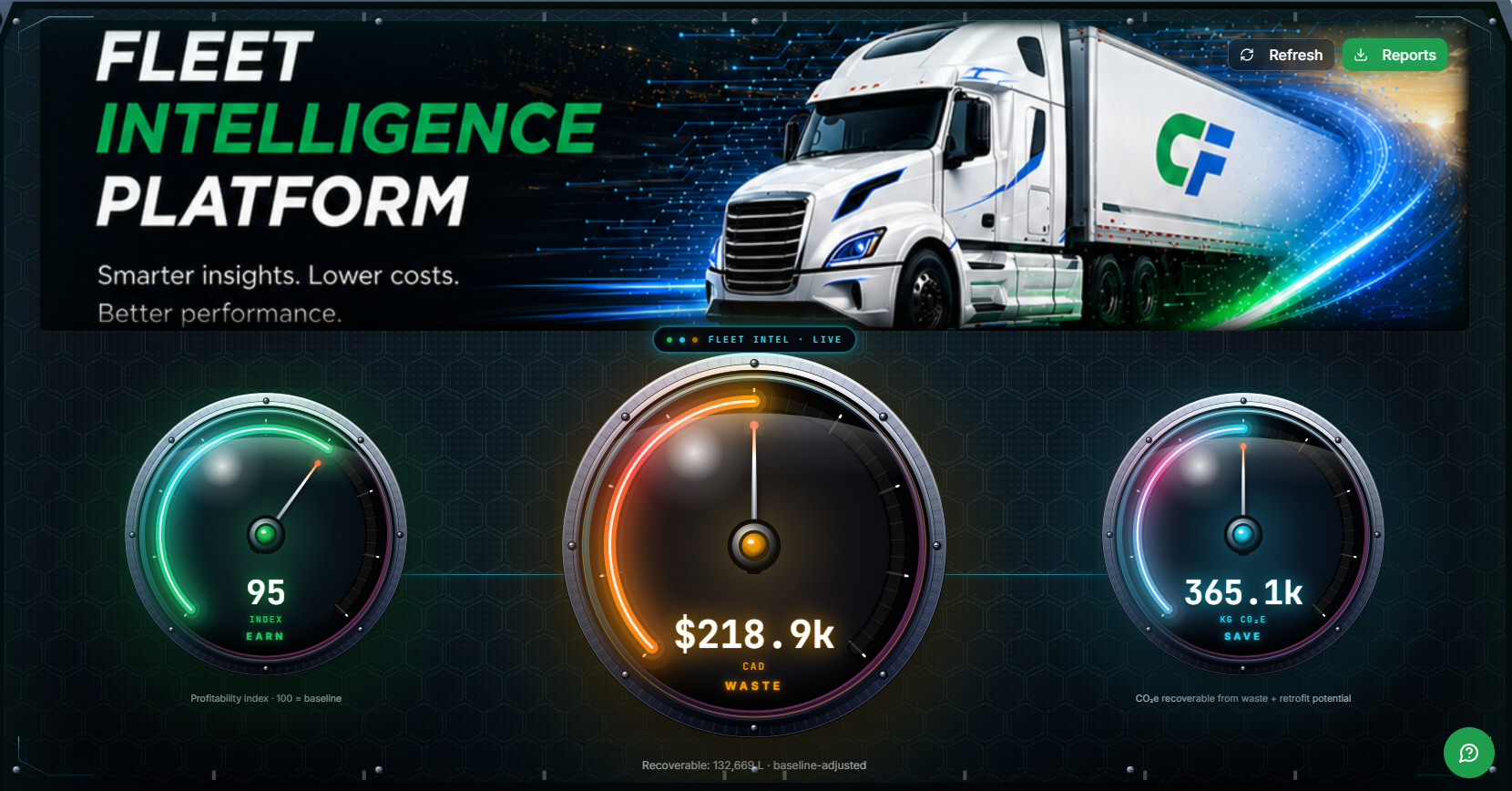
Fuel waste is usually already visible. The problem is that most fleets do not have the time, tools, or reporting structure to act on it.
After supporting more than 160 trucking fleets through fleet energy assessments, one pattern became clear: most fleets already have the data they need to find fuel waste.
The issue is not usually a lack of data.
The issue is that the data is buried across telematics platforms, fuel records, maintenance systems, driver behavior reports, spreadsheets, and operational assumptions. Fleet managers are often expected to find savings while also managing dispatch pressure, driver issues, equipment downtime, customer demands, compliance requirements, and day-to-day operating problems.
That means fuel waste often stays hidden in plain sight.
CleanFreight was built from that experience.
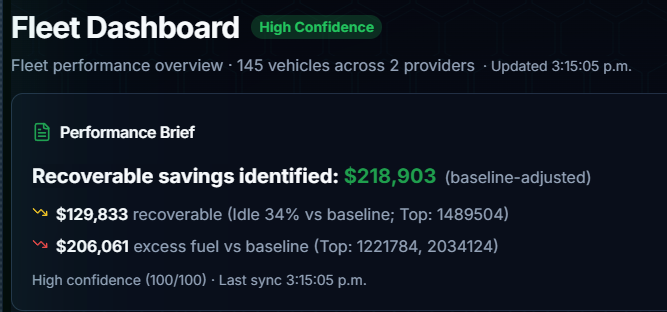
We saw the same problems repeat across fleets of different sizes, regions, equipment types, and operating models. Some fleets had modern telematics systems. Some had detailed fuel reports. Some had strong maintenance programs. Some had experienced operations teams.
But almost all of them had recoverable fuel waste.
The opportunity was not theoretical. It was measurable.
The biggest lesson: telematics data alone does not create savings
Most fleets already use telematics.
That does not mean they are extracting the full value from their telematics data.
Telematics platforms are excellent at collecting information. They show location, idle time, speed, fault codes, driver events, fuel use, engine hours, vehicle activity, and many other operational data points.
But collection is not the same as analysis.
A fleet can have years of telematics data and still struggle to answer basic profitability questions:
- Which trucks are costing us the most in fuel?
- Which units are underperforming compared to similar equipment?
- How much idle cost is avoidable?
- Which fuel losses are operational, mechanical, behavioral, or utilization-related?
- Which trucks should be investigated first?
- How much money can we realistically recover?
- Are we improving or getting worse over time?
- Can we show emissions reductions against a baseline?
These are the questions that matter.
Calculate your potential fleet Savings
Free tool
Estimate your fleet's recoverable savings
Enter your fleet size and annual fuel spend to see what a 3%, 5%, and 8% recovery is worth for your operation.
CleanFreight was designed to answer them quickly by converting existing fleet data into fuel savings, asset performance, and emissions insights that management can act on.
Fuel waste is not one problem. It is a group of smaller problems.
One of the most common mistakes in fleet efficiency is treating fuel waste as a single issue.
In reality, fuel waste usually comes from several overlapping sources.
Common causes include:
Excessive idle time Poor fuel economy from specific units Underperforming trucks compared to similar vehicles Driver behavior patterns Route and duty cycle differences Preventable maintenance issues Low asset utilization Unexplained fuel anomalies Seasonal changes Equipment mismatch Lack of consistent benchmarking
A single fleet may not have one major fuel problem. It may have 15 smaller problems that add up to hundreds of thousands of dollars per year.
That is why basic dashboard reporting is not enough.
Fleet managers need ranking, benchmarking, and prioritization. They need to know where to start.
The best fleets look at fuel waste weekly, not annually
Annual reviews are useful, but they are too slow to manage fuel waste effectively.
Fuel waste needs to be monitored like a financial leak.
If a truck is underperforming for 12 weeks, the fleet should know. If idle cost is rising, the fleet should know. If a group of trucks is trending in the wrong direction, the fleet should know. If fuel performance improves after corrective action, the fleet should be able to see that too.
This is where CleanFreight changes the workflow.
Instead of waiting for a consultant report, a spreadsheet review, or a year-end fuel analysis, CleanFreight gives fleets a recurring view of what is happening across the operation.
The goal is simple:
- Find the waste.
- Rank the opportunity.
- Act on the highest-value issues first.
- Track whether the action worked.
Many fleets underestimate non-idle fuel waste
Idle time is one of the easiest fuel losses to understand because it is visible and familiar.
But idle is only part of the story.
In many fleets, non-idle fuel waste can be just as important. This includes poor fuel economy during operation, asset-level underperformance, unusual fuel patterns, and efficiency gaps between similar units.
A fleet may already be watching idle time but still missing larger performance issues.
That is why CleanFreight separates fuel waste into clearer categories. Idle waste matters, but so does the fuel being lost while trucks are moving.
For management, this distinction is important. It helps determine whether the issue is behavioral, operational, mechanical, or asset-related.
Asset-level benchmarking is where the money starts to appear
Fleet averages can hide expensive problems.
A fleet may look acceptable on paper while several trucks are quietly draining margin. One underperforming truck may not look dramatic in a monthly report. Ten underperforming trucks can become a major annual cost.
That is why asset-level benchmarking is critical.
CleanFreight helps fleets compare trucks against baselines, historical performance, and other fleet assets. This allows management to see which units deserve attention first.
The question is not just:
“How is the fleet performing?”
The better question is:
“Which assets are creating the largest recoverable losses?”
That is where operational action begins.
Emissions reporting is becoming part of fleet performance
Fuel waste is not only a cost issue. It is also an emissions issue.
Every liter or gallon of diesel burned unnecessarily increases Scope 1 emissions. For trucking fleets, this matters for internal sustainability targets, shipper reporting, customer requests, procurement requirements, and future emissions disclosure expectations.
Many fleets are being asked to provide emissions information, but they do not always have a simple way to connect operational fuel performance to emissions outcomes.
CleanFreight helps bridge that gap.
By tracking fuel use, fuel waste, savings opportunities, and tank-to-wheel emissions against a baseline, fleets can better understand how operational improvements affect both cost and emissions.
That makes emissions reporting less of a manual exercise and more of an operational performance metric.
The strongest savings opportunities usually come from existing data
One of the most important lessons from fleet energy assessments is that fleets do not always need new hardware to start finding savings.
Many already have:
Telematics data Fuel use data Idle data Asset activity records Historical operating data Maintenance records Driver behavior information
The missing piece is usually analysis.
Cleanfreight.ca in Canada and Cleanfreight.io in the United States connects to existing fleet data and turns it into a clearer view of performance, waste, savings opportunities, and emissions impact.
That reduces the time required to find issues and helps fleets move from reporting to action.
What fleets should check every week
Based on what we have seen across fleet assessments, every trucking fleet should regularly review a small number of high-value indicators.
These include:
Total fuel cost trend Idle cost Non-idle fuel waste Best-performing and worst-performing assets Fuel economy by truck Fuel economy trend over time Asset utilization High-risk anomalies Recoverable savings opportunities Emissions against baseline
The goal is not to overwhelm management with more reports.
The goal is to show the few areas where action can produce measurable savings.
CleanFreight was built to make this easier
CleanFreight was created because the same problem kept appearing across fleets:
The savings were there, but they were difficult to find, difficult to prioritize, and difficult to track.
Cleanfreight.ca helps trucking companies identify fuel waste using their existing telematics data. The platform benchmarks fleet and asset performance, identifies recoverable savings opportunities, tracks idle and non-idle fuel waste, and generates executive-ready reporting for fuel savings and Scope 1 emissions.
No new hardware is required.
The result is a clearer operating picture for fleet owners, executives, and operations managers.
Instead of asking whether fuel waste exists, CleanFreight helps fleets answer a better question:
Where is the money being lost, and what should we fix first?
Final takeaway
After more than 160 fleet energy assessments, the conclusion is clear.
Most fleets have fuel savings opportunities inside their existing operation. The challenge is finding them quickly enough, ranking them properly, and turning them into action.
Fuel waste is not just an environmental issue. It is a margin issue.
For fleets operating on tight margins, even small efficiency improvements can have a major financial impact.
CleanFreight helps fleets find those opportunities faster, using the data they already have.
Ready to see what your fleet data is saying?
CleanFreight helps trucking fleets identify fuel waste, recoverable savings, asset performance gaps, and Scope 1 emissions opportunities from existing telematics data.
Start with your own data and see where fuel waste is hiding in your fleet.
Visit Cleanfreight.ca to learn more.
One-time report
See what your own fleet is wasting
A Fleet Fuel Waste Assessment turns 12 months of your telematics data into one report: how much fuel is recoverable, where it goes, and the 10 trucks to fix first. CA$499, one time.
Join the platform and get CA$100 back. Subscribe to the CleanFreight platform within 30 days of your report and CA$100 of what you paid for the assessment comes off your first platform invoice.