
What a fleet fuel waste assessment shows (and how it works)
A step-by-step look at the Fleet Fuel Waste Assessment: what you do, what the report shows, how your data is handled, and how fast it arrives.
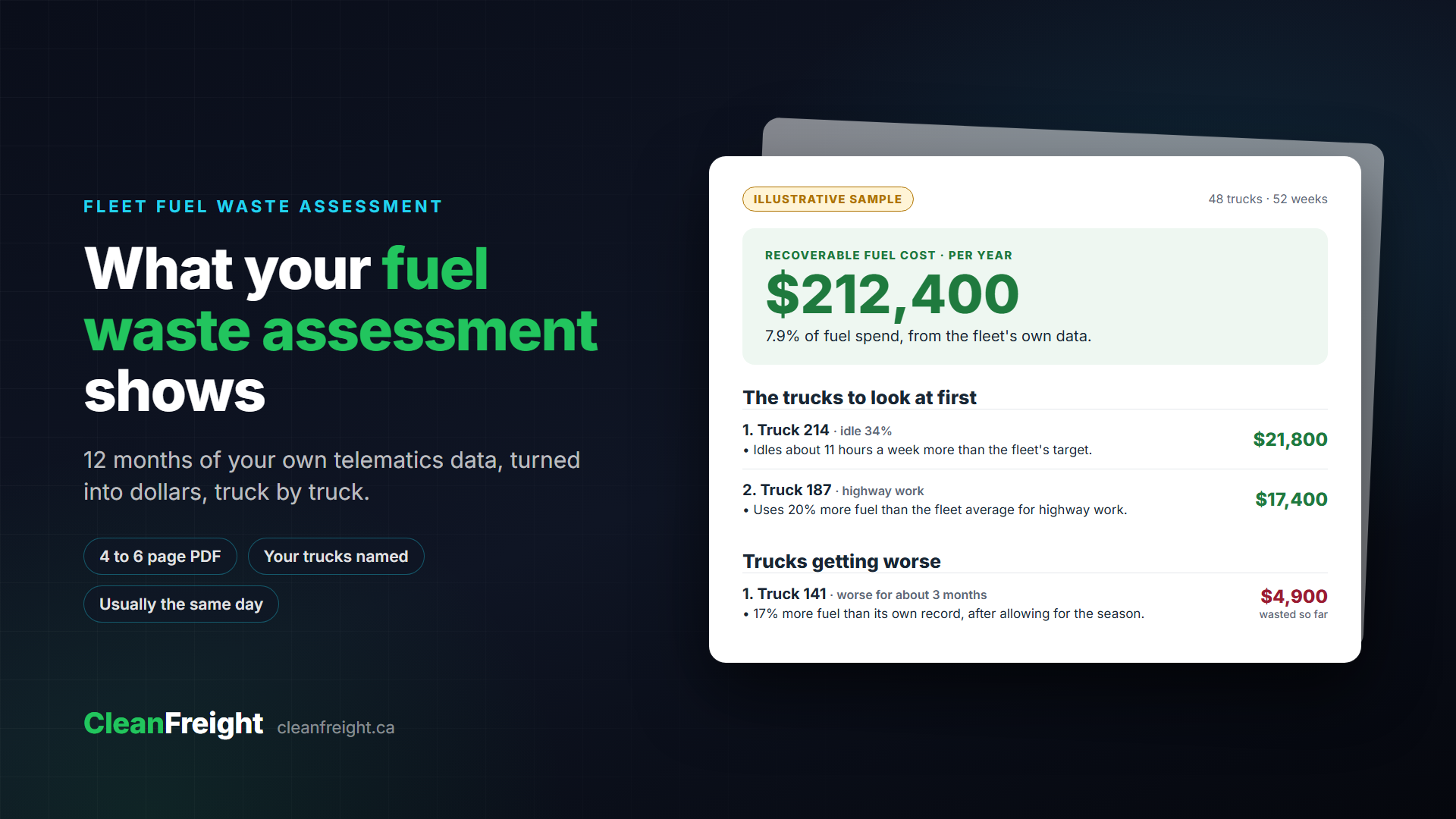
Most fleet owners have a feeling about fuel. They suspect some trucks idle too much and a few burn more than they should. What they rarely have is a number: how many dollars a year, and which trucks.
The Fleet Fuel Waste Assessment is built to give that number from 12 months of your own telematics data. This post walks through exactly what you do, what you get back and how your data is handled, so you know what to expect before you start.
How it works, step by step
1. Get an estimate on the site
On the assessment page, type in your fleet and your annual fuel. You get a quick estimate based on what fleets on CleanFreight actually recover. It costs nothing and takes a minute. If the number is not worth chasing, you can stop there.
2. Pay and create your account
If you go ahead, you pay once for the report (CA$500 in Canada, US$500 in the United States) and your account is created at the same time. Nothing is connected or stored before you pay. All sales are final. No refunds.
3. Set four settings
Next you confirm four settings, so the report is worked out the way you would work it out yourself:
- Diesel price. Used for every dollar figure. It starts at this week's national average, and you can change it to what you actually pay.
- Idle fuel burn. How much fuel a truck burns per hour of idling. About 4 litres an hour is typical for a highway tractor.
- Idle target. The share of engine time you consider normal idling. Anything above it counts as excess. 30% is a fair target for most fleets.
- Fleet type. Used to compare you with assessed fleets that do the same kind of work.
4. Connect read-only, or upload 12 monthly files
If you run Samsara, Geotab, Motive or ISAAC, you connect in a few clicks with read-only access. On any other system, export its vehicle performance report for each of the last 12 months and upload them, one file per month, oldest first.
5. Get your report, usually the same day
Connected fleets: most reports are ready within an hour. Uploading files? It is ready as soon as your 12 monthly files are in. We email you when it is done.
What the report shows
The report is written in plain language and names your own trucks. It covers:
- Recoverable dollars a year. How much fuel your fleet can recover, from 12 months of your own data.
- Where the money is. The split between excess idling (idle hours above your target) and the fuel-economy gap between your trucks. The gap is found by comparing each truck with the fleet average for the same kind of work, highway, mixed or city, so city trucks are not unfairly compared with highway trucks.
- The 10 trucks to look at first, each with a plain reason, such as heavy idling or burning well above similar trucks.
- Trucks getting worse. Up to 10 trucks whose fuel economy has slipped against their own record for two months or more, adjusted for the season. These usually point to a mechanical or driver issue worth checking. For each one: how much worse it is, what it has cost so far, and what it will cost in a year if nothing changes.
- Your 5 best trucks, so you can see what good looks like in your own fleet.
- Month by month. Fuel economy and idle share for each month, so seasonal swings are easy to spot.
- How you compare. Your numbers next to assessed fleets of the same type, over the same months of the year.
- How it was worked out. The method and the settings used, explained plainly, so anyone in your office can follow the figures.
To give a sense of scale, one 39-truck drayage fleet we assessed was idling 50% of its engine time. The idling above a 30% target alone came to about $151,000 a year at CA$2.68 a litre (Canadian average, week of Oct 20, 2026), or 8.3% of all the fuel it bought. The full report adds the fuel-economy gap on top of that.
The report is a 4 to 6 page PDF. You can download it or email it to yourself to share with your team.
How your data is handled
Handing over fleet data is a fair concern, so here is exactly how it works:
- Nothing is connected or stored until you have paid.
- Read-only access: we only read trip, fuel and engine data and never change anything in your system.
- Remove our access the moment your report is done.
- Your fleet data is stored in Canada and deleted within 30 days of closing your assessment, unless you join the platform.
Nothing is installed in your trucks, and nothing in your telematics system changes.
An optional review call
The assessment price covers the report. Some fleets want to walk through the findings with someone who has done many of these. For that, a 30-minute review call with Clean Freight Consultants is available separately for CA$150 once your report is ready. We go through your report, answer questions and point out what to do first. It is entirely optional; the report stands on its own.
$100 back if you join the platform
The assessment is a one-time look at the last 12 months. If you want to keep tracking fuel week by week after that, the CleanFreight platform does it with the same data.
If you subscribe within 30 days of your report, $100 of your assessment comes off your first CleanFreight platform invoice (CA$100 in Canada, US$100 in the United States). There is no obligation to subscribe.
Get started
If you want a clear number for your own fleet, start with the free estimate and go from there. Canadian fleets: get your Fleet Fuel Waste Assessment at cleanfreight.ca. Fleets in the United States can use the US site, with pricing in US dollars: cleanfreight.io/fuel-waste-assessment.
Examples are real fleets from Clean Freight fuel assessments, with names withheld. Idling above a 30% idle target at 4 litres an hour, priced at CA$2.68 a litre (Canadian average, week of Oct 20, 2026).
One-time report
See what your own fleet is wasting
A Fleet Fuel Waste Assessment turns 12 months of your telematics data into one report: how much fuel is recoverable, where it goes, and the 10 trucks to fix first. CA$500, one time.
Join the platform and get CA$100 back. Subscribe to the CleanFreight platform within 30 days of your report and CA$100 of what you paid for the assessment comes off your first platform invoice.